And Why That’s the Wrong Question to Ask Right Now
Warning: This piece touches on the very sensitive subject of rape, sexual assault, consent, regret, and responsibility. While my intent is to open up a broader conversation, I am aware that this is a discussion that many in our society are not prepared to have. And as such, I am aware that some people may struggle with what I am presenting and why.
A Question With No Workable Answer
A little further in this piece, you will find a poem I wrote as a reflection on the news of Jane Doe versus what people are calling The Cornell 7—seven men accused of sexually assaulting a young woman after her initial consent to an alcohol and ketamine fueled sexual encounter with two of them.
I wrote the poem after talking with my college student daughter who was understandably struggling with the information. She would talk about her feelings, move through various emotions, and then punctuate her assertions with the question, “What’s wrong with men?”
As I was listening to her, I understood why she was asking the question. I have asked it myself for my own reasons. But, underneath the very valid question and all the justifiable frustration, I got the sense that there was more to be asked and explored. If we simply try to have a conversation around “What’s wrong with men?” the answers this question might yield would do nothing toward actually solving our challenges. So, over the next however many words it takes, I am going to hold the energy of that question while listening for deeper possibilities. I hope that you will be patient with me as I do this.
See Something, Say Something, Get Silenced
Now, I can imagine that some people are already struggling with how I presented this initial introduction. I’ve already had a few people challenge me over different ways that I have expressed myself regarding this situation. So, I can only imagine that more will come out of this expression. For example, I can definitely imagine some people feeling that my acknowledgment that Jane Doe initially consented to “an alcohol and ketamine fueled sexual encounter with two of them” is coming from bias. They might imagine that I am on the path of victim blaming. Why else would I start off by saying that she consented at first, right?
Well, if anyone is assuming that, they’d be incorrect. I am only saying it because that is what Jane Doe actually said. And I think it is very relevant to hold that in tension with everything else we revisit. Because, in my opinion, to ignore what she said she consented to is just another way of silencing her or being selective in what we give attention to in order to validate our own position. By acknowledging what she said and letting it inform what I write, my intent is to honor her power to name both what she consented to and what she didn’t consent to. For me to do otherwise, would feel incongruent. But, like I said, I anticipate someone challenging me on this. That’s okay though. Because, I am open to learning. So, feel free to share other perspectives. Some folks already have.
One criticism that I received from a man was that I shouldn’t be discussing this at all. To use his words, “You weren’t there. So, you shouldn’t be talking about it.” And another man accused me of bringing it up as a “weird move to get attention from women”. These are two more pieces of feedback that I can add to my collection of things that men have said to me when I say something that acknowledges the humanity of women. Other things that men have said to me include that I am an ideal candidate for a “Bill Gates artificial vagina”, my face looks like a vagina talking, and a wish that a drug addict assaults my then six year old daughter so that I stop being a “Prophet of the Wishy-washy Gospel” and learn to practice Biblical manhood. So, yeah, I get why the question, “What’s wrong with men?” gets asked.
On the flip side, I had a woman say to me that I shouldn’t say “This Cornell thing is getting to me” and instead say the word rape. Another told me that words are nice but I need to think about all my male friends that probably raped or assaulted women and call them and tell them, “I remember what you did” and also look back on if I ever raped or assaulted a woman and own up to it. Again, I get why putting myself out here opens me up to these kinds of perspectives.
But, I share these responses because I think it is important to communicate that I am not bringing this up as if I am in a silo. I know that there are consequences for speaking up and that not all of them will be received as I intended. But, I am going to speak anyway. Part of it is because I have to stay in my own soul’s integrity. And the other part is because I think it is important to communicate that the toxic elements of our culture that lead to responses like these men and women made is the same reason why both men and women stay silent or become complicit in harm like the assault that happened at Cornell.
This is a reader-supported publication. To receive new posts and support my work, consider becoming a free or paid subscriber.
Be a Coward “Like a Man”
Earlier today, I read an article by a man named Waylon Lewis called, “I’m a man and here’s how I feel about the Cornell 7 case.” In the article, he talks about how there are a lot of men who care but who don’t speak up because they either feel guilty by association or they are afraid of speaking up and saying something “wrong”.
I appreciate him naming this because I know that there are a lot of men like those he described who want to speak up on issues. But, they are scared to because not only will they get attacked by some of their fellow men—which gets their hearts beating fast—they fear that the people they are trying to support will attack them too. And, I have to be honest, they’re probably not wrong. Besides the comments that I have received over the years from both men and women on whether I should speak at all or whether I am speaking up the “right” way, I have had much harsher experiences with physical, emotional, psychological, relational, and even financial consequences for breaking from the patriarchal, misogynistic, racist, and colonizing culture that we’re all a part of. And yet, I speak up because if I don’t, I am actually betraying myself, which is the first step to betraying others.
“In the end, we will remember not the words of our enemies, but the silence of our friends.”
Rev. Dr. Martin Luther King Jr.
I have had a lot of years to think about why so many “friends”—to use Martin Luther King Jr.’s words—don’t speak up. As I described in my post, Death Where Is Your Sting, as a teenager I was jumped by a bunch of kids on the school bus. And as I was getting punched and slapped and kicked, I looked around for my only friend and saw him standing off to the side looking helpless. Of course, this brought up a lot of complex feelings. But, what I have learned through literal blood, sweat, and tears is that most men—or anyone who doesn’t speak up or step in—when they see harm being done don’t stay silent because they are terrible people. They stay silent because they are scared people.
Even when the consequences seem low stake, like simple saying rape is wrong regardless of how the woman got in the situation, most people fear standing out so much that they become intoxicated with fear and simply go into impersonal ego defense or say nothing at all. And yeah, if you are the person being harmed, you would hope that someone would do something. But, I hate to say it, our current social climate is indicative of the fact that right now the majority of us just can’t do it—men and women alike.
Generally speaking, when people feel like they are in a “damned if you do, damned if you don’t” situation, most of us will become paralyzed with fear. I know this is tough on women. But, an added element for men in this culture is that we are told that we can’t be afraid. We are instructed that Fear = Death. Very few of us question that education. So, instead of admitting our fear, we do a whole lot trying to look like we’re not afraid. Of course, this is bullshit. But, it is very convincing bullshit. So when fear moves through many of us, we go into denial. We are convinced that to admit we’re cowards is a death sentence. And in a warring culture, as is most prevalent in this country, there is some substance to this fear.
For men, this often creates a triple bind when it comes to finding the courage to speak up. First off, they are scared. Second they are scared to admit they’re scared. And finally, they are ashamed of being scared. That’s how toxic this environment is for men—most of whom would never do anything harmful on purpose, but also would never call it out.
This culture is so toxic that we have normalized war and rape culture to the degree that scared men feel like they should at least get some credit for not SAing people. That’s why it hurts so much if they get over their fear of speaking up only to get attacked for not speaking up “like a man”, which everyone knows euphemistically means without fear. Let’s just call it what it is.
And if they get attacked for speaking up “wrong”, they are not supposed to feel anything or cry about that either. They are supposed to take all the criticism “like a man” too, which again euphemistically means to “take a licking and keep on ticking”. But, no one sees the irony that what our system is asking of some men is actually as crazy making as what we’re asking of women. That’s why I think instead of—or at least in addition to—asking “What’s wrong with men?”, we should ask some of these other more generative questions.
- What are we so afraid of that prevents us from speaking up on behalf of others?
- What are we afraid would happen if we admitted to being afraid?
- What would we need to create in our culture to reduce this fear?
- What secondary benefits of the status quo are we willing to give up in order to create a new more loving and safe community for all people?
The reason why I am asking questions like this is because, as it stands, it seems to me that just like gun advocates claim that “the only thing that can stop a bad guy with a gun is a good guy with a gun”, many of us unconsciously hold the belief that the only ones who can protect people from bad men with toxic masculinity are good men and women with toxic masculinity. Be honest. We don’t want our men to be scared. We don’t want our men to get their feelings hurt when they try to speak up and get called out for doing it “wrong”. We don’t want our men to not know what to do and be paralyzed with indecision.
Almost everyone wants men, on no matter what side of an issue they are on, to be direct, decisive, unflappable, and willing to die for what they believe in. And dammit, that is not how most men have ever been, Heck, in the Bible, all of Jesus’ male disciples ran and hid after he was arrested. The toughest one acted like he didn’t know him and denied him three times. And when he was dying on the cross for trying to stand up for those marginalized by the systems of his time, only the women in his life and only one man, John aka “the disciple Jesus loved”, were there. Kind of like things still are today.
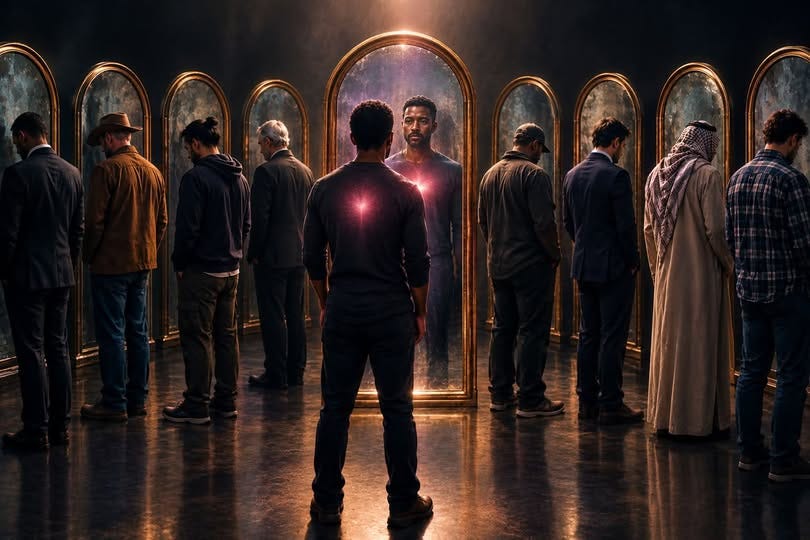
The Battle in the Mirror
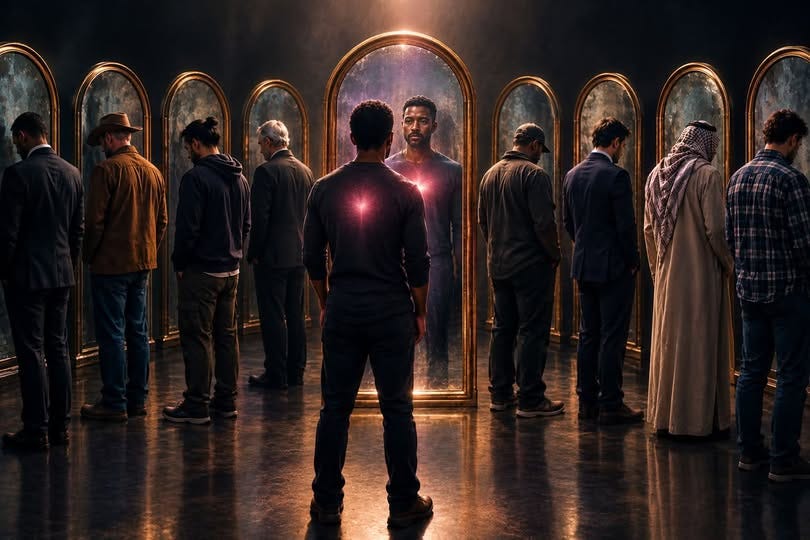
For now we see only a reflection, as in a mirror, but then we will see face to face. Now I know only in part; then I will know fully, even as I have been fully known. And now faith, hope, and love remain, these three, and the greatest of these is love.
1 Corinthians 13:12,13
Paul of Tarsus
What do I do with this rage that’s rising?
I went to bed angry
I woke up angry
Thinking that my daughters go out into this world asking, “What is wrong with men?”
And I don’t know what angers me more
That they are asking the question?
That I don’t have an answer?
That any of us think that having an answer will solve the problem?
So, instead of looking for an answer,
I take it to the Silent temple in the depths of my being
I am waiting for the awareness that I am not in reaction or retaliation before acting
I want every choice I make to be as conscious as possible
Because this harm was created by the unconscious ones
Knowing this, how can my unconscious reactions serve the cause of awakening even when I mean well?
And yet, I’m unsure of whether this is the “spiritual thing to do” or if I’m just making excuses for not saying what I want to say:
Men did this
Weak men did this
Mostly so called Christian weak men did this
And it doesn’t matter what this is,
If it is awful and in this country,
It is almost always weak men who do this
And whatever IT IS, it is always worsened by even weaker men
Who don’t say anything because they are afraid of weak men too
Just like the rest of us.
How did we get like this?
What kind of magic spell have they cast to convince capable people that we are powerless?
Is it because courage has an expiration date
And weakness has a longer shelf life?
How do we keep missing the memo?
It only takes a little light to cause the darkness to flee
This little light of mine
I’m going to let it shine.
Shine first in the caverns of my own soul
Show me, without blame, shame, or justification,
Is there anything of those weak men in me?
Perhaps that’s what scares us the most—
Is there a light at the end of the tunnel
Or is what I thought was a tunnel actually just a cave?
And am I too afraid to find out that there is no other side?
To find out we are stuck like this?
To find out that I’m not the man who meets the moment just like so many?
What if I go too deep and the light dies while I’m surrounded by darkness?
That’s a question weak men ask.
But here’s the answer that might surprise you
The greatest form of strength is acknowledging one’s weakness.
And the greatest form of weakness is pretending to be strong when you’re not.
There is no value in winning battles over 10,000 enemies only to lose the battle with the mirror
The greatest shame is to avoid one’s own reflection and to live in terror of the Silence.
If you fear the condemnation of your own thoughts, you’re condemned already
And so I look at myself and listen in the Silence for what words can’t express
My rage has become art
The souls of weak men have become clay
I shape their formless substance into the image and likeness of strength perfected in weakness
It’s a creative act only Love can perform
If there is anything in me that will not let me be the man the moment demands, I let it go—even if it is the whole world.
Childish Things
When I was a child, I spoke like a child, I thought like a child, I reasoned like a child. When I became an adult, I put an end to childish ways.
1 Corinthians 13:11
Paul of Tarsus
So given all that I’ve shared, when people ask why so many men are so silent on so many issues, all I can say is that is because at an early age we were educated to fear the same men everyone else has been raised to fear.
It’s not an excuse. It’s an explanation. And it is made worse by the fact that most men are often abused into turning their faces away from other people being abused. Either that or they join in to protect themselves. Then the same system that tells women to keep their heads down and accept whatever happens to them as not ruin men’s lives tells the men that they have to keep everything inside and take care of all of life’s struggles alone. So they end up taking their pain out on anyone and anything they think can’t fight back and can keep their secret that most of us are scared little boys who want guidance and protection too. I’m saying this from both experience and exposure. So what do we do? With all that going on underneath the surface, it sounds like—as my kids say—“We’re cooked.” But we’re not cooked if we have wisdom and will.
Aristotle said, “Give me a child until he is 7 and I will show you the man.”
What were any of us taught up until 7? That will show you where most of our impulses are coming from—men and women. And unless we are very intentional about nurturing new ways of being together, most of us will do as adults what we were trained to do from birth to age 7.
Just like many of us don’t say things because of what we were taught. I say things because of what I was taught before 7 and what I chose to intentionally nurture as an adult.
What can serve us right now is community. We have to carry in our bodies what we idealize for the world. And be willing to bring to environments what we would want others to do for us in our vulnerabilities—even if no one has ever done it for us.
When I said earlier that if I don’t speak up when my soul is leading me to, it is a betrayal of myself, which is the first step in betraying others, this is what I was talking about. I wanted someone to step up for me. I need to step up for others. “Do for others as you would have them do for you.” That’s what we need to normalize.
To do that, we need a vision for ourselves and our communities that has the capacity to both heal what’s been broken and redeem what broke it. We have to name the harm done. But that is just the first step. We have to listen to those harmed. Then we have to create new safe and spacious systems that have room for us to rediscover ourselves. We have to be able to revisit our 0-7 selves, re-examine what we were taught and systematically retrain even in the face of all that might come up—the fear, the shame, the loneliness, etc. And once we create communities and systems that honor the humanity in all people, we can create re-education systems for those coming out of denial and are willing to exchange a patriarchal, misogynistic, racist, colonizer mindset for a community mindset.
There’s a reason why Jesus taught that in order to vibrate at the frequency he emanated or enter into the consciousness he articulated one must change and become as a child. It’s because he recognized where the cognitive distortions started.
There’s a reason he said don’t call anyone on earth your father. There’s a reason why he ignored his mother and brothers and asked, “Who are my brothers, sisters, and mother?” And then answered, “Those who do the will of God”, Who according to the book many claim but know very little about, is Love itself. God is Love.
This is not about religion as we’ve been taught it from age 0-7 by the colonizer and the colonized. There’s no denying that the same colonizing rape culture that got us into this mess has been co-signed by religious people. And Christianity in particular has a horrible track record. But the narrative that everyone should be able to agree on is that it was those same religious people who killed Jesus then that are still killing folks mentally and physically today.
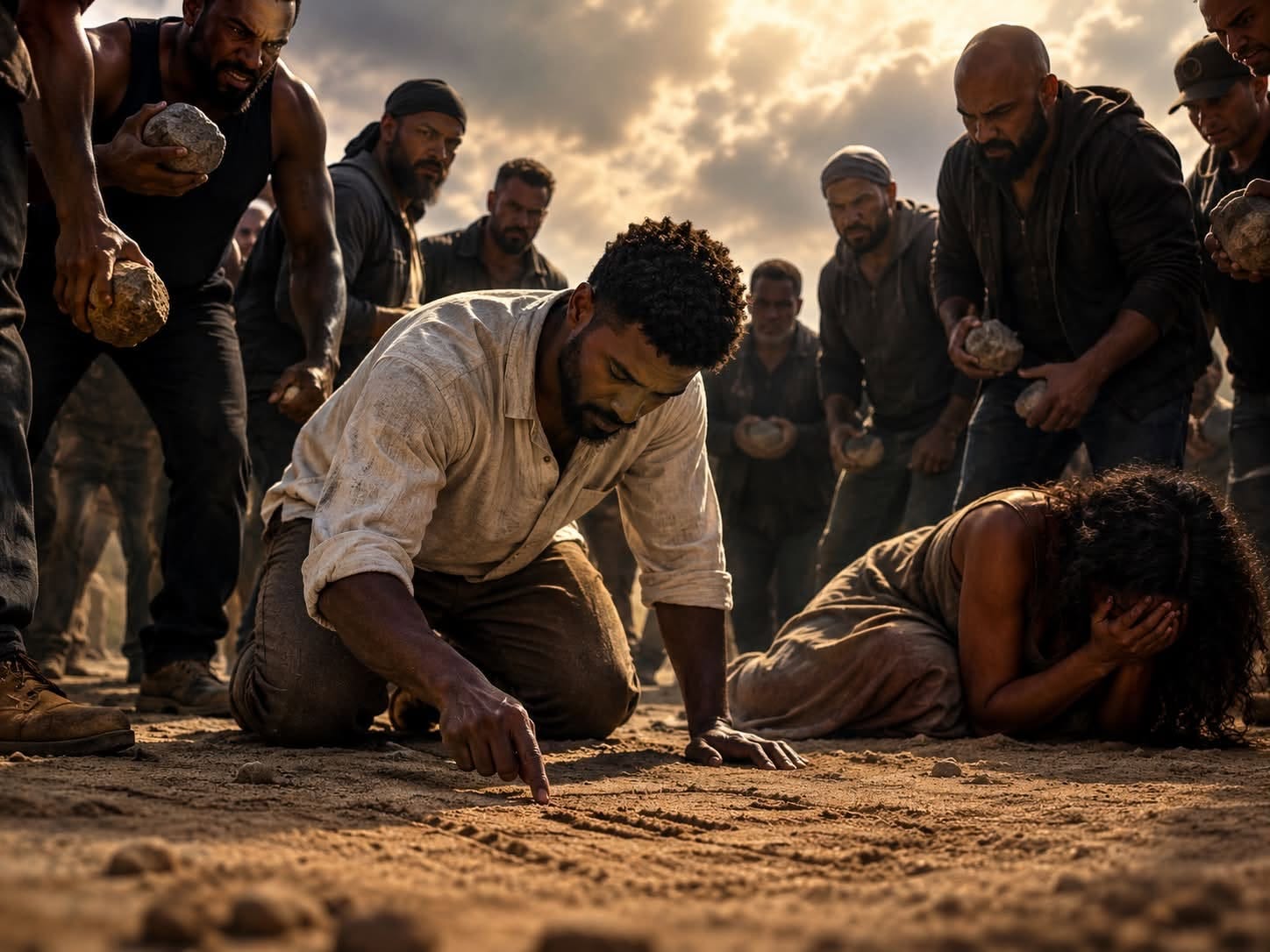
But, I’ll tell you that before I was 7, I read the story of a man who saw other men pursuing a woman and trying to kill her for sleeping with a man who wasn’t her husband. And that man got between her and the mob, and with his words, stopped them all. He showed them their error and he then asked the woman, “Where are your accusers?” Followed by “Neither do I condemn you.”
For reasons both expressed and not expressed yet, I resonated with that woman and wished there was someone like that man who would step up for me. Then later I read that that same man said that what was in him was in all of us and that people will know those who follow his teachings “BY OUR LOVE”. So as a child, I chose that man as my teacher. I’ve been on a search for how to live up to that ever since. And one thing I’ve learned in all of these years is that he always teaches from the ground, not from the penthouse. There’s a reason why he taught “what you do to the least you do to me.”
There’s a reason why 2000 years ago when it was definitely not in vogue, Jesus honored women and children, defended women and children, and trusted women and children with his identity. There’s a reason why they say a woman was the first to see him resurrected while the men were in a room hiding. Even if you see the story as simply allegory or metaphor, what it is teaching is undeniable and clearly still relevant.
If you want to know who is following the teachings, you’ll know by their Love, their service to who this society ignores, and who they’ll get on the ground with and speak up for. And finally, as he taught his students, don’t expect a reward for doing what you’re supposed to do.
Silence Is an Option, For Some
Now of all the things that I have shared that might not land with some of you, I suspect that this may be the hardest pill to swallow. I have come to accept that silence is an option for some people. We can keep trying to fight the fact that some people say nothing and some people say something in the “wrong” way if we want to. Or we can face the real fact that has always been in our faces. People are scared. And many of us, in our efforts to protect our children, instill fear in them. We tell our boys to not cry. We tell our girls not to trust men. We tell our gender non-conforming children to pick a side, and everyone complains that shit is taking to long to change. We just keep doing the same things over and over. We keep asking the same questions that have no generative answers. And way too many of us wait for someone else to do what we want them to do before we do what we can do—even if all we can do is post a message on social media saying “Rape is wrong.”
Finally, I am not putting this out because I think I have all of the answers. I am putting it out here, because I want to add more questions to the conversation and I want to invite more people to talk about what is actually happening instead of a whole lot of “shoulds” that are not grounded in our actual experiences.
Scared people are doing scared people things. Answering what they are afraid of goes way further toward creating a better world than asking what’s wrong with them. Wondering what happened to them offers the possibility of answering what it would take to heal them. Being curious about what they were taught, introduces potential for reeducation. Asking what kind of culture can makes excuses for rape opens the door to asking what kind of culture we can create that normalizes care for others and honors people’s chosen boundaries. And asking what it would take for people to move out of cowardice and into community, can fundamentally reshape how we respond to people’s awkward attempts to move beyond their comfort zones.
Of course saying all this does not negate harms that have been done and are being done. It does not absolve perpetrators. Nor does it explain away impacts. But, it also does not trap any of us in the perpetual violator victim paradigm that kills possibilities.
“The world breaks everyone, and afterward, some are strong at the broken places.”
Ernest Hemingway
“The oppressor would not be so strong if he did not have accomplices among the oppressed.”
Simone de Beauvoir
“For the master’s tools will never dismantle the master’s house. They may allow us temporarily to beat him at his own game, but they will never enable us to bring about genuine change.”
Audre Lorde
“No project is completed until the perpetrator has faced what they have done… Healing is a two way street; the oppressor must also face the damage they have done to their own humanity.”
Alice Walker


Leave a Reply