
“Women are the true architects of peace. Their strength, resilience, and wisdom have the power to transform societies and build a more peaceful world.” – Sanam Naraghi Anderlini, MBE, Founder and Executive Director of the International Civil Society Action Network.
Yes. This title is provocative. But, we are in perilous times and sometimes you have to do what you have to do to get people’s attention.
Yin With No Yang
Let me start by asking you a series of ignorant questions. They are ignorant because I already know my answer to them and assume that only a person who is vehemently against harmony and peace would bother fighting with me about what I am trying to (and will likely fail at) articulate. But, as a kind of filter, I am placing these questions here to help frame my argument with the hope that those who want to fight will self select themselves out of this conversation. I am however, open to well thought out arguments from a different perspective. I try to stay open. So let’s get into it.
- Would you try to drive a car with only two wheels?
- Would you trust a plane that only has one wing?
- Would you place your food on a table that only has two legs on one side?
If your answers to these questions are yes, please save us both some time and stop reading here. But, if your answers are no, then can you help me understand why we trust governments, organizations, and systems that essentially function at half their capacity by not having the balanced perspectives of a reasonable number of women represented in leadership? This is a question that I have been asking myself as I, on a daily basis, watch the degradation of much of our fragile nations, organizations, economies, etc. Of course, I know many of the stale arguments that folks will use to explain away the reality that for millennia, men have been running the show, and yielded the outcomes that most folks agree are unacceptable. So, the last thing I want to do is engage in one of those conversations. But for the sake of an argument that may catalyze transformative discourse, I am willing to get into it.
I’m not going to pretend like I have the answers. I don’t. I mostly have a lot of questions. Even though that’s difficult to tell considering all of the words that are about to follow. But, rather than wait until I did have the answers, I decided to put this half baked argument out here in the hopes that people will participate and offer some clarity to this cloudy situation.
You Know an Input By Its Output aka You Know a Tree By Its Fruit
In order to even begin writing this piece that I have been wrestling with for months, I had to do work to silence the voice in my head that tries to tell me that it is not my place to speak on this subject. And once I started writing, new thoughts arose telling me to be quiet, and warning me that by titling this piece as I have and trying to start a conversation about our system’s insufficiency in hearing women’s voices, I might be putting myself in the crosshairs of what John Sanford and George Lough, authors of What Men Are Like identify as the “exhausted male ego”–the egotistic crisis of the midlife male coming to terms with the fact that they may never fulfill their younger ego’s ambitions.
However, despite every notion that I probably shouldn’t write this, I am pushing through this even though I have had the hardest time even coming up with the language to express how I want to approach the question this title asks. All I know is that something has to change in our societies. Just look at where we are. With all of the resources and technologies that we have at our disposal, how have we not developed the relational capacity to create societies that work better for more people? Why are we still motivated by a conquering mindset rather than a community mindset? And when we look at where we are, why can’t we be honest about who’s been steering the ship toward an iceberg so to speak?
I know that some people will get agitated by me asking these questions. But, the way you troubleshoot a problem is most often working back from the outcome you don’t want using something called the half-splitting method. This was something I learned when I was in the military. It is usually applied to electronics. But, it is an analysis tool that can be used in a variety of settings to determine why we aren’t getting the results we’re looking for.
I’m a firm believer that to get different outcomes, we have to change our inputs. Plain and simple. So when I saw how the women in the documentary, The Abortion Talks worked out their differences while maintaining their personal integrity, I had to ask myself the last time I saw men do this. That’s when the question of where the founding mothers are came to my mind. I don’t know why the question never came to mind before. I’m almost embarrassed to admit it. But, as a Black man who is mindful that my people were not considered human at the founding of this nation, I may have been distracted. But, seeing the modeling that they were able to offer on what has been a wedge issue in this country for decades was more than admirable. It was transformational rather than simply transactional. And I realize that it took significant labor to give birth to the relationship they developed. Labor far too many of us are not taught to put in. And yet, we say we want the outcomes such as those they produced.
The status quo is always the most likely outcome. Movements that are the most effective are not the the ones that have the best strategy but the ones that have the most strategic capacity. – Hahrie Han, Political Scientist and inaugural director of the SNF Agora Institute
In the work I do to bring people together across differences, I do my best to communicate to folks that without guidance and intention, we are doomed to repeatedly create new iterations of the same old thing. We have to develop the conversational courage these women had and the wherewithal to sit with the discomfort, or at least make commitments to return to the circles when we need to temporarily step away. We also need to struggle with language. Often we are using the same words, yet speaking a different language. If we can’t come to terms with this and nurture a better way of communicating with one another, like these women did in the film, we will continue to foster misunderstanding and yield the fruit of the status quo.
The Way of the Wise Women
When I was a child, my mother had a group of women friends that called themselves the Arrownettes. They had been friends ever since they were children and they always had each other’s backs. Among them, there were a dozen of us boys who, for most of my formative years, spent a significant amount of time around each other. So much so that we all called each other cousins and treated each other as such. These women had a profound effect on me. In an environment that had fewer men, they were the leaders. From them, I learned about the virtues of community and the Sacred as well as the gift of vulnerability.
Even though they were strong women individually and collectively, their willingness to be emotionally raw around, with, and sometimes even at each other while maintaining relationship showed me that the agitation that many of us try to avoid in our relational encounters is often–when navigated with commitment–what is necessary to build sustainable bonds. And beyond this, they were able to create a narrative among them that was spacious enough for all they had been as well as for who were they were in the process of becoming.
Unfortunately, as an adult, I have not seen this kind of bond represented much in popular culture or as welcomed in larger society. In America, we seem to be a nation of weak bonds, choosing to believe that we can do everything on our own. And I think way too many of us are suffering needlessly because we are too busy armoring ourselves against the possible pain of being seen in all of our messiness.
Is a Better World Possible?
If you haven’t seen the 2022 film Women Talking, based on the book by the same name by Miriam Toews and inspired by a true story of women living in an isolated Mennonite community in Bolivia who endured terrible abuse, I highly recommend it. It does an excellent job of demonstrating what it would take for oppressed people to pursue a better world including the tensions that one feels when extracting themselves from a harmful, yet manageable known into a mysterious Unknown filled with positive potential. In the novel, that the author describes as “an imagined response to real events,” she envisions the possibility of imagining a better world through deliberation, conversation, and tough decisions.
Two of the overarching themes in the film are power and forgiveness in the context of individual and community commitment to one’s faith. In many ways, I could imagine people being terrified by the questions the film asks the watchers to entertain. In their simplicity, they leave folks with very little room to deny that the women’s basic humanity was essentially denied. And if you’re paying attention, you can see how even in the most progressive countries, there are remnants of this foundational principle of women as second class citizens at play. And sadly, just as it showed in the film and as Paulo Freire outlines in his book, Pedagogy of the Oppressed, “The oppressors, who oppress, exploit, and rape by virtue of their power, cannot find in this power the strength to liberate either the oppressed or themselves.”
Root Cause Analysis
I hope I am wrong. But, my brain can imagine several male friends and even some women who will be disturbed by what I am suggesting–most especially those in so called Westernized “first world” settings. They will, point to many examples of women in leadership positions and call it progress. But, as Malcolm X said, “You can’t stick a knife nine inches into someone’s back, then pull it out six inches and call it progress.” True progress will take a lot more work. Even after the knife is pulled all the way out, the stabbed person remains vulnerable and requires healing support, rest, and once they are on the mend, opportunity. Of course, we can justify anything we want to. That’s one of the gifts and curses of the human narrative faculty. We can look at a few examples of isolated women leaders and tokenize them and put them in positions where not only do they have to bear the weight of being the only and likely the first in their roles. They also have the representative pressure of paving the way for others to come behind them. And I can tell you from experience as the first or only Black person in several situations, that is a heavy burden to carry.
Let’s take Vice President Kamala Harris for example. When I opened my iPhone yesterday, there was an article entitled The Kamala Harris Problem. Now, don’t get me wrong, I understand all the political reasons behind why some people may have a problem with Madam Harris. But, I’ve lived through numerous administrations and as far as I can tell, there has been more concern about her fitness and abilities than any other VP in history–most of whom seemed to have disappeared in between election cycles. The standards that people hold her to do not match the standards that they’ve held any other male VP to. And, as I have experienced with many other female leaders, people say things like, “I just don’t like her” and yet have very little ability to explain why.
I’ve even talked to women, who can’t explain their dislike for her or other women leaders. As a pastor, I knew a lot of people (men and women) who didn’t like women pastors. But, they rarely could express why. And that’s despite the fact the most churches have a lot more women in their membership roles. I think it is an unconscious bias that tells us that leaders are supposed to be men. It’s what most of us have been taught for most of our lives with the exception of teachers and nurses. It just feels weird to us. But, I think we need to examine where these notions are coming from rather than simply surrendering to it because that’s the way it’s always been.
Powerful Beyond Measure
If you want another example, let’s consider Marianne Williamson, who despite her clear intelligence, is being virtually ignored in her Presidential bid. It’s one thing to disagree with her or think she is unqualified solely based on the fact that she’s never held office. But, she made an admirable showing in the 2020 debates and yet, when people spoke about others running for the Democratic nomination for 2024 only RFK was mentioned. Why? I think it’s programming.
I’ll even throw myself under the bus and admit that years ago I was sent an email with this amazing quote:
“Our deepest fear is not that we are inadequate. Our deepest fear is that we are powerful beyond measure. It is our Light, not our Darkness, that most frightens us. We ask ourselves, who am I to be brilliant, gorgeous, talented, fabulous? Actually, who are you not to be? You are a child of God. Your playing small does not serve the World.There is nothing enlightening about shrinking so that other people won’t feel unsure around you.We were born to make manifest the glory of God that is within us. It is not just in some of us; it is in everyone. As we let our own Light shine, we consciously give other people permission to do the same. As we are liberated from our own fear,our presence automatically liberates others.”
This was in the 90s and like many people, I heard that these words came from Nelson Mandela in his 1994 inauguration speech as President of South Africa. This quote had a profound effect on me. So, much so that I used to have an alarm set everyday for me to read the quote. The thought that Nelson Mandela could spend decades in prison in his freedom struggle only to emerge with grace, poise, strength, and forgiveness in his heart was amazing. And then to uplift his people and the world with this quote. How could I not take this into my heart and try to hold it as a beacon when I met life’s struggles. The only thing was Nelson Mandela never said this. They were Marianne Williamson’s words.
Now, I would love to say that being raised by virtually all women and having dedicated my life to trying to be as equitable as possible that I simply shrugged my shoulders and excepted that the quote came from a different source than I had expected but was still as valid as I ever thought it was. But, what I initially felt was disappointment. First of all, I had no idea who Marianne Williamson was at the time. And secondly, because I hungered for a powerful Black man as an aspirational symbol, I wanted the words to belong to Mandela. And in a way that is admittedly unreasonable, I almost was offended by Marianne for saying them.
Thankfully, I value being able to look myself in the mirror. So, I confronted my own ignorance and returned to the gratitude that I felt for the words. And as a bonus, I was able to eliminate some of my male leadership bias and ignorance from my system that I didn’t know was there. And some years later when I became a father to daughters, I knew that I wanted my girls to know those words and contribute to a world where they knew they were “powerful beyond measure”. That’s why when my oldest was in fifth grade, we would recite those words on the commute to school. And ironically some years later, I ended up in an online conversation with Marianne Williamson and Grover Norquist among others through Living Room Conversations and was able to let her know that I had my daughter memorize her words.
I share all of this realizing that this piece is only scratching the surface and in no way answers the question that the title poses. It isn’t enough to say that the “founding mothers” are simply suppressed and oppressed by the “fathers” aka the male dominant patriarchal systems. And it would be unfair, disingenuous, and ignorant of me if I didn’t acknowledge that there are many women throughout history and in this present moment and in every corner of life who are doing everything in their power to bring harmony to the world and some who are causing direct harm. And of course, there have always been men who are not threatened by women in leadership and have nurtured and cultivated that capacity wherever they can. I am just saying we need to do more. And to hearken back to the opening quote from Sanam Naraghi Anderlini, I believe that women are essential to creating space for peace we need to aspire to.
Sweet and Sacred
There’s a scene in the documentary, The Abortion Talks, where one of the subjects of the film talks about the profundity of her and the other five women featured in the film simply sharing a dessert together. As she describes the scene with them all sitting at a table in a restaurant putting their six spoons into the dessert, I could feel how moved she was. And I couldn’t help but be moved as well. I could feel myself being transported to that moment with her. And in imagining these six women–three who are “Pro-Life” and three who are “Pro-Choice”–and all of whom, were it not for the tragic events that brought them together, probably wouldn’t have developed a kinship, I felt, what I could only undeniably call, the Sacred.
When I gave a talk on peacemaking recently, called “The Pedagogy of a Peacemaker”, I asked those assembled if they could describe peace for me. Besides describing it as “the absence of violence”, no one except the moderator, Randall Butler, had a working idea of what peace meant to them. And yet, everyone agreed that peace was good and that they wanted it.
That’s why this documentary was so powerful. Despite their differences and everything that told them that they should not build a relationship with one another, these six women were able to do so because they were committed to peace. And not simply the conditional and transactional peace that has been witnessed all over the world, which is often nothing more than the absence of present violence contained by the threat of future and greater violence. What they embodied is transformational and relational peace, which is the presence of true community. First came commitment. Then came peace. But, that’s not what we’re taught.
Ultimately, those folks not knowing how to describe the peace they said they want, was not a shortcoming on their part. But, it is an indication that we need peace education. It has not been a part of our social pedagogy. And yet, we expect it from one another.This saddens me deeply. Now let me ask you sincerely, how can we desire something if we don’t know what it is? Peace is not passive. It is wholly active and transformative and resides beyond the simplified designations of right and wrong. Like love, it calls us into expanded community and a larger more inclusive narrative that embraces cognitive dissonance and says, “I am. You are. We are.”
When Time Touches Eternity
There are moments in history that I experience as “thin places“–a term usually reserved for physical locations where the mundane and the magnificent touch, where heaven and earth are not felt as separate, but rather as eternally now. One of those moments for me was the instance where Martin Luther King Jr. and Malcolm X shook hands while they were in Washington as the Senate debated the 1964 Civil Rights Act. It stands out to me because it symbolizes the coming together of seeming opposites. And to my surprise that’s what I felt when I heard Barbara Thorp, Director of the Pro-Life Office of the Archdiocese of Boston recall that moment and remember thinking to herself, “This is Good”. And she wasn’t talking about the dessert.
When I reflect on these moments that demonstrate the possibilities of peace, I feel a sense of everything in our vulnerable human lives coming together. The pleasure and the pressure, the relational and the reactionary, the living and the lying and all of the many complexities of the human experience feel held in the embrace of something beyond human understanding and I feel assured that, despite everything that I might see, peace will one day be our guiding light.
What is Good?
In the Hebrew scriptures, each “Day of Creation” is declared “good” by the Creator. So, in many ways, I have come to see good as the highest form of praise. And yet, how many things in life can we say are truly good? In the documentary I am in, This Is [Not] Who We Are, “a film exploring the gap between Boulder’s progressive self-image and the lived experiences of its Black citizens”, I acknowledge that, as I see it, many of our issues in society come from most of us wanting to look like “good people” but, like peace, not really knowing what that actually means. Trying to manage perceptions so that we come off as being seen as good to the people whose approval we crave, many of us don’t take the opportunity to be better people. I think that, in part, this is because to become better in the future, we have to acknowledge our past and present limitations now–something many of us are too often unwilling to do. And yet, paradoxically, when we do, we experience “the Good”, just as those women did.
When Two Become One
Peace and unity are good. That much I know. That was what those women tasted in the relationships they cultivated with one another in secret and over five and a half years. And that is why I believe that the Abortion Talks is one of the most important documentaries of the past decade. Before I saw it, I didn’t know it was something my soul was hungry for. But after seeing the film at least half a dozen times due to hosting house parties and other screenings through the organization I serve with, YOUnify our partnership with Mormon Women for Ethical Government, I can say that it hits the spot every time.
One of the biggest challenges in doing the work of bringing people together across differences in support of individual and community thriving is helping people see just how much they have in common. In an era of identity politics, many of us have a difficult time experiencing what unites us with people who have identities other than those we hold most dear. We genuinely believe that people have opposites. We don’t. Men and Women are not opposites. Black people and White people are not opposites. None of us are the opposite of one another. We are a part of one another and when we have both wings, together we can fly.
An Opportunity to Practice
The event below is an opportunity to wrestle with the work of peacemaking and and an invitation to potentially connect to the peacemaker in us all. If you are local to Boulder, please join us for this event. Please bring a friend. Please bring someone with whom you disagree. Bring your peace.
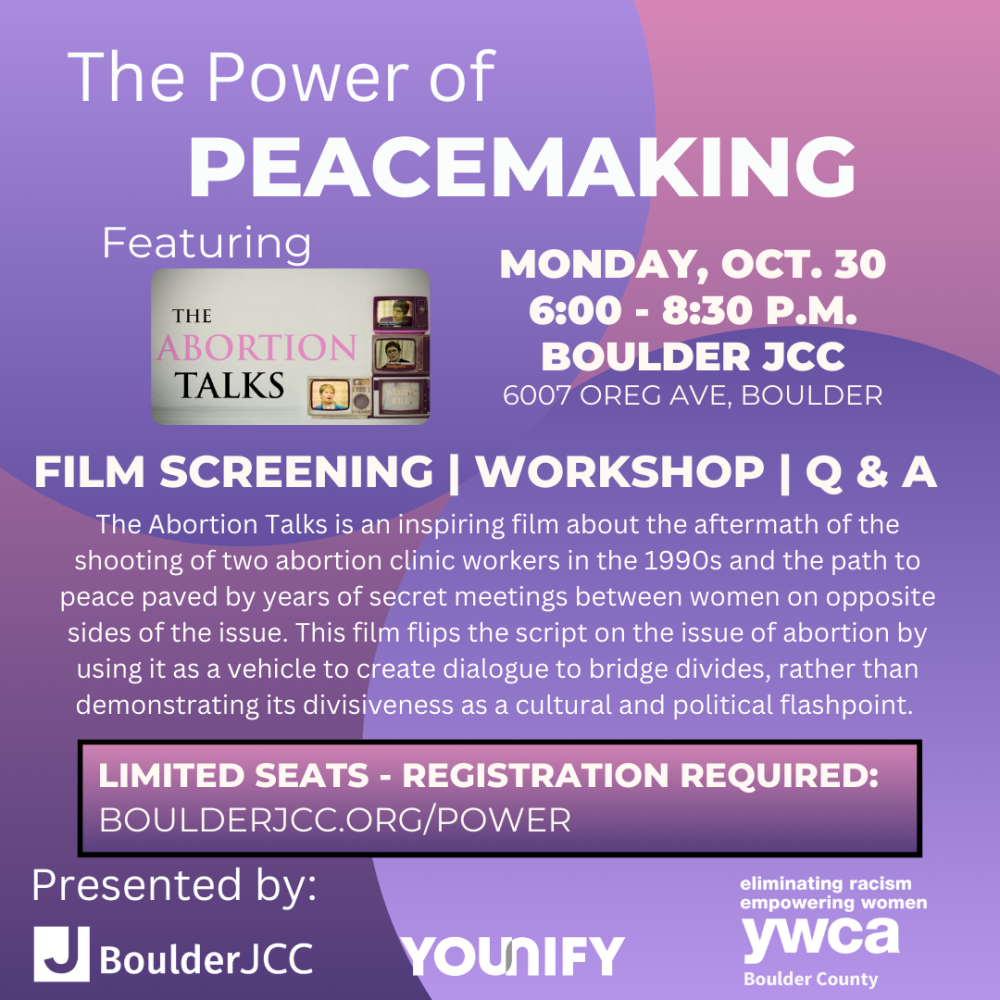
What: The Power of Peacemaking featuring The Abortion Talks documentary
When: October 30, 6-8:30PM (Doors open at 5:30)
Where: The Boulder JCC @ 6007 Oreg Ave Boulder, CO
The register, just click here.
This engagement is brought to you in partnership with YOUnify, the YWCA of Boulder, and the Boulder JCC. It will be followed by a mini-session on how to approach difficult conversations and a Q and A with the filmmaker. If you have any questions, please feel free to contact me.
About the Film: In the aftermath of John Salvi’s murder spree at two Brookline clinics, leaders from opposing sides of the abortion debate met together in secret talks. None of the participants would change their minds, but the dialogues changed their lives. THE ABORTION TALKS follows the crimes, trial, and murder of John Salvi—and the story of six women, all of them leaders in the pro-life and pro-choice movements, who sought to ensure that it would never happen again.
 The Roofless Church
Leave a comment